


Is AI infrastructure simply a "new opportunity" to add to your portfolio?
At first glance, computing power, energy systems, and data centers may look like another thematic line item that you append to an existing allocation list. However, in Noah Holdings' H1 2026 CIO Report ("CIO report"), we present a different judgement. From the perspective of global asset allocation research, AI infrastructure is closer to a portfolio bedrock than a thematic addition. It is evolving into a new generation of foundational alternative assets that merit long-term study.
The difference lies in the role these assets play within a portfolio. When an asset class begins to influence portfolio stability, correlation patterns, and cash flow characteristics, it is no longer just an option. It becomes a foundational building block.
The "Core Judgment" series continues to distill key conclusions and methods from the CIO report and help readers reset long-term direction in a time of faster structural change.
What Are Bedrock-Type Assets, and Where Does Their Core Value Lie?

In asset allocation, not all assets serve the same function.
Some provide growth elasticity. Others capture trends or hedge specific risks. A third category plays a more fundamental role and provides structural stability and long-term carrying capacity for the entire portfolio.
The CIO report suggests that a mature and rational portfolio often shows a layered structure. The bottom layer provides stable support. The middle layer enables dynamic adjustment. The top layer calls for disciplined risk control.
From this perspective, a frequently overlooked long-term risk in AI investing is not missing a particular opportunity. The greater risk is standing at the wrong asset layer, using mismatched tools, or taking on volatility that does not align with one's risk tolerance.
As a new frontier within alternative asset research, the value of AI infrastructure does not lie in replacing technology equities, private equity, or venture capital. Its value lies in providing structural complementarity:
Potential returns are driven mainly by long-term and predictable usage and service demand.
Its role in the portfolio is to reduce structural uncertainty and volatility.
It enhances diversification and the dispersion of assets across global market.
Cash Flows, Correlations, and Volatility Management: Why Structure Matters More Than Theme
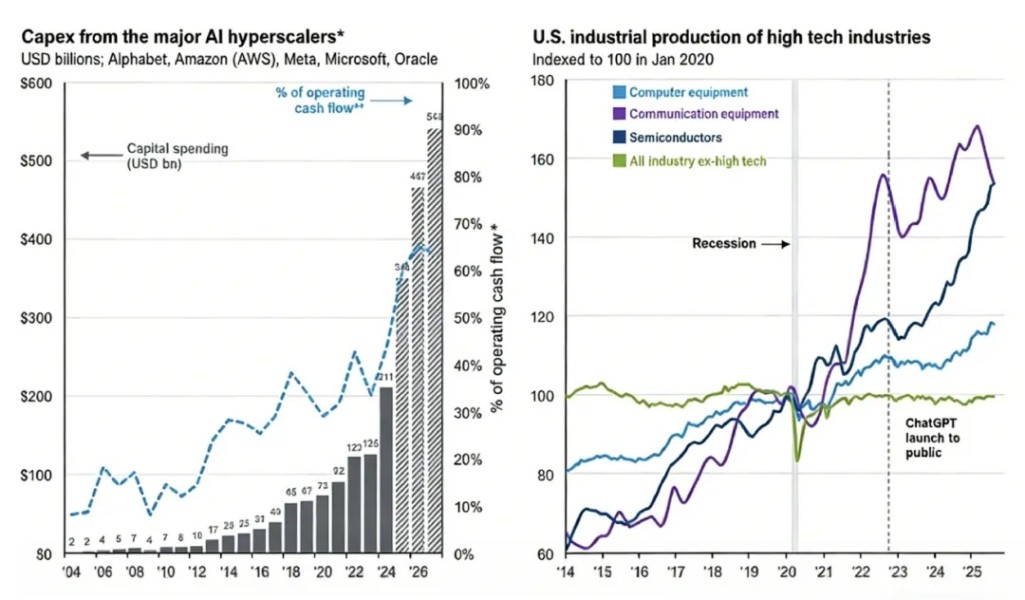
Capital Expenditure Levels of The Five Major Technology Companies & Output Levels of The US High-Tech Sector
Data sources: J.P. Morgan, Bloomberg, US Federal Reserve
If AI infrastructure is viewed only through a thematic lens, it can be mistaken for another technology asset. From a portfolio construction perspective, however, its significance lies less in its technological features and more in its distinct cash flow profile, correlation structure, and volatility behavior.
First, its cash flow characteristics. AI infrastructure supports the continuous operating needs of the entire AI ecosystem rather than a single company or application. As a result, potential returns are driven by long-term usage, capacity expansion, and foundational services, not by short-term technology cycles.
Second, its correlation structure. In long-term allocation, outcomes are shaped less by the return of an individual asset and more by how assets move in relation to one another. The return drivers of AI infrastructure differ in meaningful ways from traditional equity exposures or concentrated technology themes. This creates distinctive structural value within a multi-asset portfolio.
Third, its volatility management functions. Markets driven by narrative often show amplified fluctuations. In contrast, assets anchored in usage and service demand are more likely to show volatility that is moderated by durable, long-term fundamentals.
The CIO report emphasizes that AI is not only reshaping the technology sector. It is also catalyzing a broader global reallocation of capital. A disciplined approach is to place portfolios within indispensable asset layers of the AI expansion cycle through structural allocation rather than thematic accumulation.
The Real Role of AI Infrastructure in a Portfolio
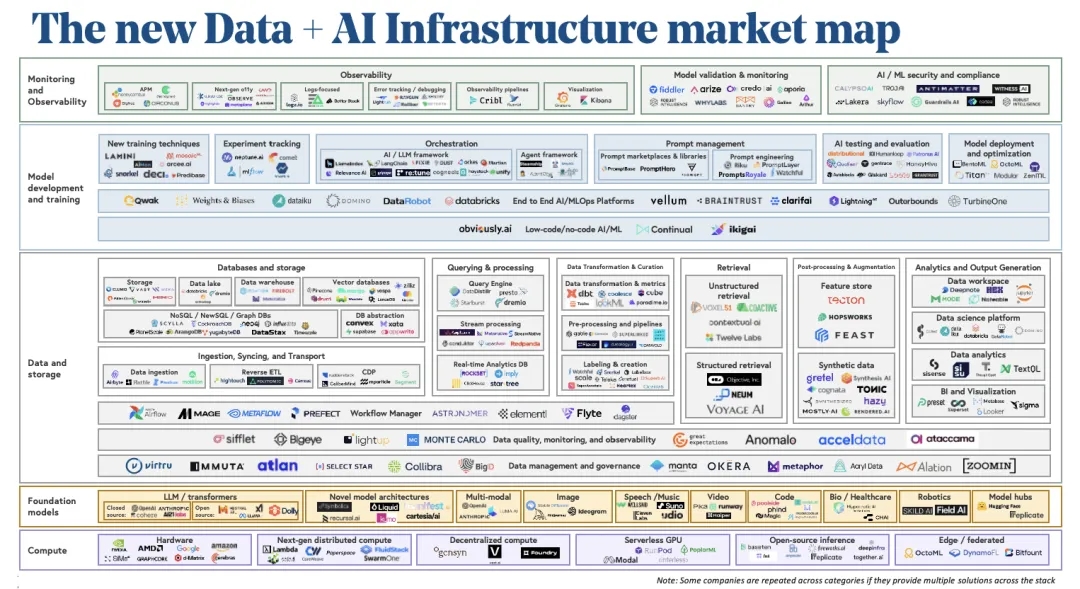
The new Data + AI Infrastructure market map
Source: Industry Research Market Map
Note: AI has evolved from a single-point technology into a full-stack industrial ecosystem.
The research framework of the CIO report underscores that the critical question is not whether one selects the right company or specific technology. The more important question is whether a family's asset structure is positioned to participate in a robust and sustainable way in this historic transformation.
Within this context, AI infrastructure serves three core functions:
1.It operates as a new generation of foundational carrying assets within the alternative allocation system.
2.It functions as a connector and a buffer between rapid technological evolution and long duration of capital.
3.It enhances long term stability and global dispersion in multi asset portfolios.
As AI moves from experimental innovation to mission critical infrastructure, the systems that support it are no longer only industry opportunities. They are structural components of the global production system. Allocating AI infrastructure is therefore not the same as adding another block to a portfolio. It strengthens the foundation.
To support structured allocation for global Chinese high-net-worth families, Noah's CIO Office has introduced a Three-Layer Asset Structure framework for the AI value chain. This framework groups AI-related assets into distinct levels. Each layer serves a different strategic function within a long-term allocation architecture.
For a full discussion of the conclusions and the asset structure analysis, please refer to the CIO report.

Scan the QR code
To access the full H1 2026 Noah Holdings CIO Report