
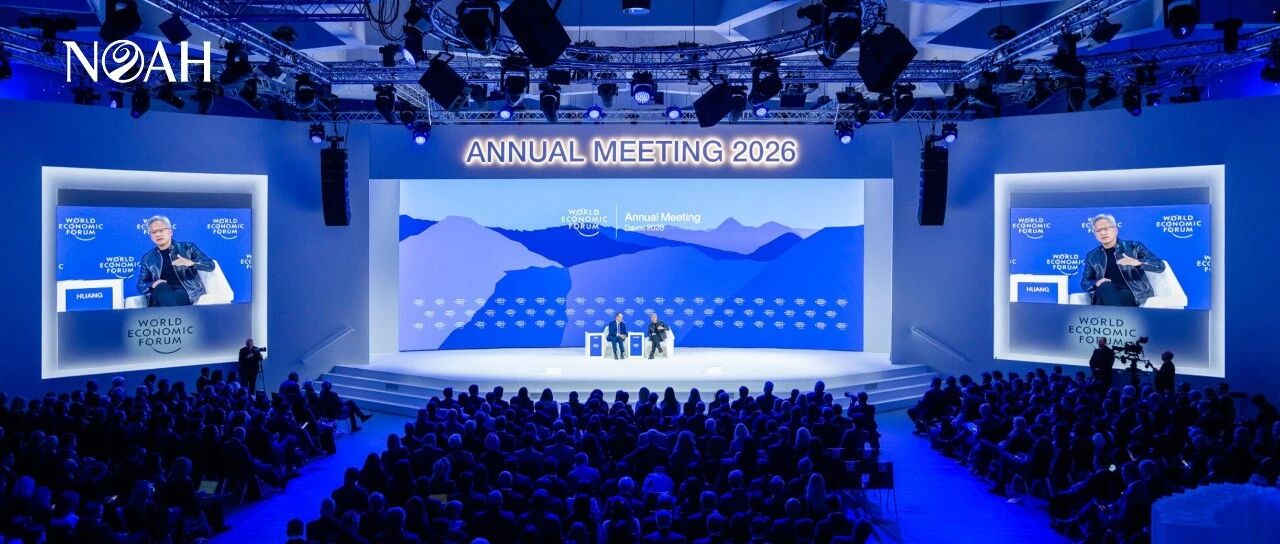
At the 2026 World Economic Forum in Davos, global industry leaders, including Jensen Huang and Elon Musk, expressed a strong consensus on the trajectory of artificial intelligence (AI). AI is no longer a single-point technological breakthrough, but the beginning of a long-term infrastructure cycle spanning energy, capital, labor, and national capability.
Jensen Huang: AI Is The Largest Infrastructure Build-Out In Human History
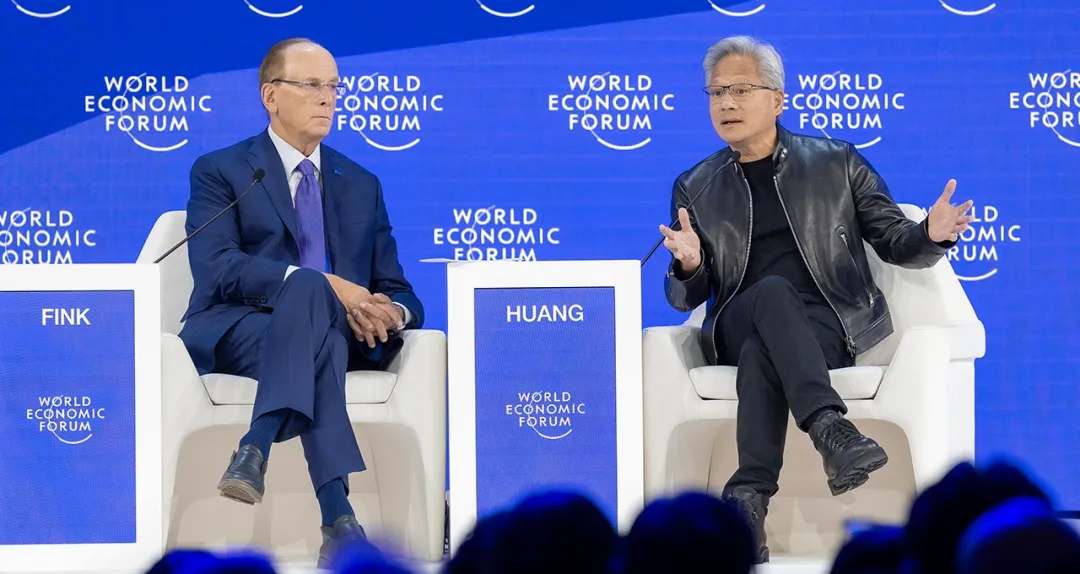
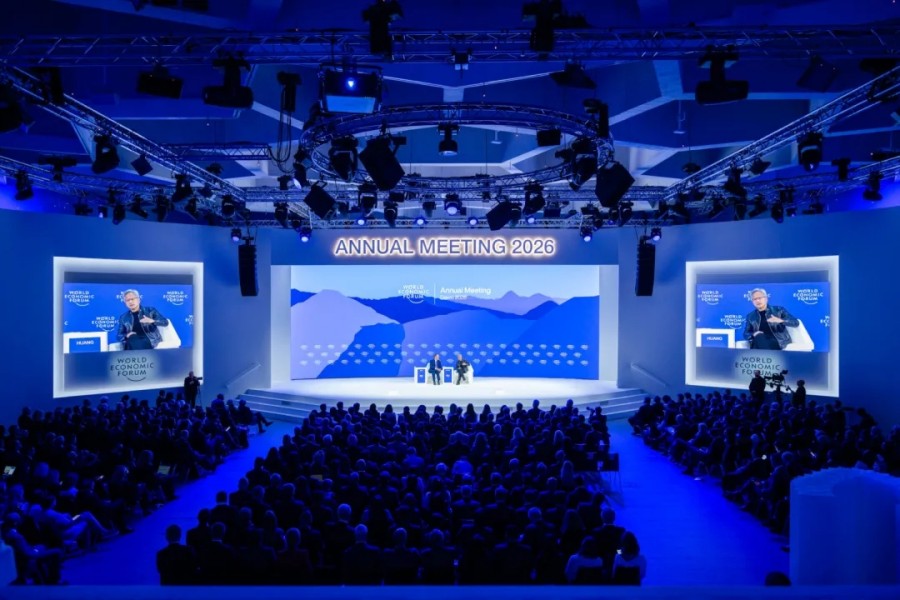
Jensen Huang (right), Source: NVIDIA
Jensen Huang, Founder and Chief Executive Officer of NVIDIA, described AI during a main-stage dialogue as "the largest infrastructure build-out in human history." He emphasized that it will drive employment growth across the global economy.
Huang illustrated the AI ecosystem as a "five-layer cake." It starts with the foundational layer of energy supply, followed by chips and computing infrastructure, cloud data centers, AI models, and finally the application layer. This structure implies that AI expansion does not benefit a single technological segment alone. Rather, it will generate sustained and systemic demand across energy, construction, advanced manufacturing, cloud operations, and application development.
In Huang's view, AI should be treated as a component of national infrastructure. "AI is infrastructure," he stated. "Every country should treat AI like electricity or roads." This perspective suggests that AI's future development will extend beyond corporate-level technological competition to include national investment capacity, institutional choices, and long-term capital allocation strength.
As Larry Fink, Chief Executive Officer of BlackRock, noted during a dialogue with Huang, the central question facing markets today is not whether AI is in a bubble, but whether AI is receiving sufficient investment. As all five layers of the AI ecosystem advance simultaneously, capital demand exhibits structural and long-duration characteristics rather than representing a short-term thematic rotation.
Elon Musk: The Core Bottleneck Is Energy, Not Chips
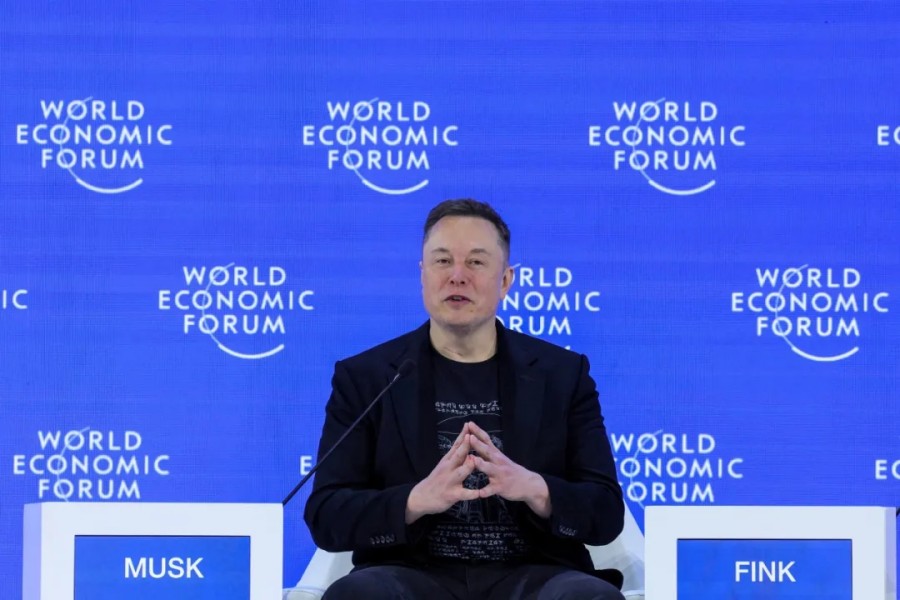
Source: World Economic Forum, REUTERS/Denis Balibouse
Also speaking at Davos, Elon Musk, Chief Executive Officer of Tesla and SpaceX, addressed AI's long-term development from another critical constraint.
Musk argued that the principal bottleneck for AI is not chip capacity but energy supply. While chip production capacity is expanding at an exponential rate, global electricity supply is growing by only 3%–4% annually. Around 2026, the world may face a structural imbalance, with an oversupply of computing power but insufficient electricity to support it.
This suggests that AI competition is shifting from a race for computing power toward the sustainability and scalability of energy systems and physical infrastructure. Musk emphasized that the Earth's solar photovoltaic potential remains significantly underutilized and highlighted China's construction capacity in solar and nuclear energy.
CIO Report: AI Infrastructure as a Structural Complement in Long-Term Portfolios
Source: World Economic Forum, REUTERS/Denis Balibouse
From the perspective of long-term asset allocation, the assessments expressed at Davos align closely with the core framework outlined by Noah Holdings Limited (Noah) in its H1 2026 CIO Report ("CIO report"), titled "Global Wealth Reshaped in the Age of AI: Growth, Allocation, and Legacy."
The CIO report emphasizes that AI is not a single-point market opportunity, but a profound, durable, cross-cycle transformation of the global production system. AI infrastructure is expected to become a key direction for global capital expenditure over the next 10–20 years, and an important structural complement within investment portfolios.
Within the CIO report, Noah systematically articulates its asset allocation logic for AI. AI infrastructure is not a thematic trade, but a foundational asset that can serve as the base layer within a portfolio. It does not replace technology equities, private equity, or venture capital. Rather, it forms a structural complement, helping to reduce overall volatility and enhance cross-cycle stability.
The report further notes that as AI becomes a global production factor, no single market can fully capture the entire AI value chain. The core of global asset allocation is shifting from single-market or single-stock selection toward constructing structural portfolios capable of participating in long-term technological expansion and industrial evolution.
For growth-oriented clients who fully understand the inherent volatility, proactive participation in the expansion of the AI value chain remains appropriate. For RMB-denominated households, diversifying away from single-currency and single-economy risk while capturing differentiated layers of AI value across regions has become a central objective of global allocation.
For a comprehensive discussion of the conclusions and detailed wealth allocation analysis, please refer to the CIO report.

Scan the QR code
To access the full H1 2026 Noah Holdings CIO Report