


In Noah Holdings' H1 2026 CIO Report ("CIO report"), we outline a three-stage framework for the evolution of artificial intelligence (AI): models, applications, and now infrastructure.
If the defining variables of the first two stages were algorithmic breakthroughs and application innovation, then upon entering the third stage, AI's growth logic is undergoing a critical shift—from engineers to balance sheets.
Against a backdrop of elevated macro uncertainty, this CIO report does not attempt to forecast short-term market fluctuations. Instead, it identifies long-term structural certainties that are gradually taking shape. The staged evolution of AI is one such direction that warrants sustained attention.
The "core judgment" series distills the key conclusions and methodologies from the CIO report to help readers reset their long-term orientation in an era of accelerating change. This issue centers on three central questions: How should we understand AI's three-stage framework? Why is capital expenditure replacing technology narratives as the dominant driver? And why is AI infrastructure emerging as a new generation of core long-term assets?
AI's Three-Stage Framework: Models — Applications — Infrastructure

Noah's CIO Office observes that AI's growth engine is shifting from engineers to balance sheets. A review of AI's development trajectory reveals three distinct stages:
Stage One: Algorithmic and model breakthroughs. Advances in model capability, parameter scale, and inference efficiency served as the primary drivers of technological progress.
Stage Two: Application exploration and commercial experimentation. As diverse use cases accelerated into real-world deployment, market attention shifted to business models and monetization pathways.
Stage Three: Infrastructure construction and scaled deployment. AI is moving from "usable" to "scalable." Demand for computing power, electricity, data centers, networks, and cooling systems is rising significantly.
As we enter 2026, AI is at the outset of this third stage. The most notable change is not further gains in model capability, but a systemic rise in capital-expenditure structures. Increasingly substantial and sustained investment is flowing into computing centers, power systems, data centers, and related infrastructure.
Viewed through a longer historical lens, every transformative technological wave that reshaped economic structures ultimately crystallized into infrastructure—long-term assets embedded in the economy: railways and power grids during industrialization; land and transportation systems during urbanization; and data centers and communication networks in the internet era.
AI is now repeating this process.
Why Capital Expenditure Matters More Than Technology Narratives
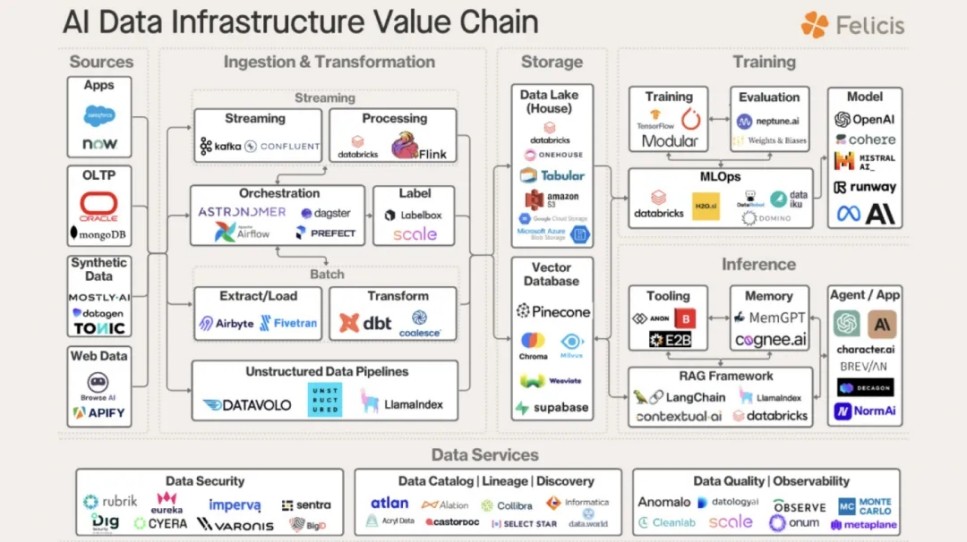
Figure: AI Data Infrastructure Value Chain Across the Full Lifecycle— from Data Collection to Model Training and Inference
Source: Felicis Ventures (AI Data Infrastructure Value Chain)
In AI's first two stages, technology narratives largely shaped market expectations. Stronger models, faster inference, and imaginative application scenarios quickly fed into valuation discussions.
As AI enters its third stage, the constraints are changing. What truly limits expansion is no longer algorithmic capability, but whether sustained investment in computing capacity, energy systems, networks, and data centers can be maintained.
This marks a decisive shift: growth is determined less by who tells the better story and more by who can invest at scale—and endure.
At this stage, the resilience and carrying capacity of corporate balance sheets are more decisive than individual technology narratives.
For wealth management, this is crucial turning point. When capital expenditure becomes the core variable, investment analysis can no longer rely on short-term narratives. Instead, it must return to structural considerations—economic cycles, balance-sheet strength, and the sustainability of long-term cash flows—to understand AI's enduring impact.
Why AI Infrastructure Is Emerging as A New Generation of Core Long-Term Assets
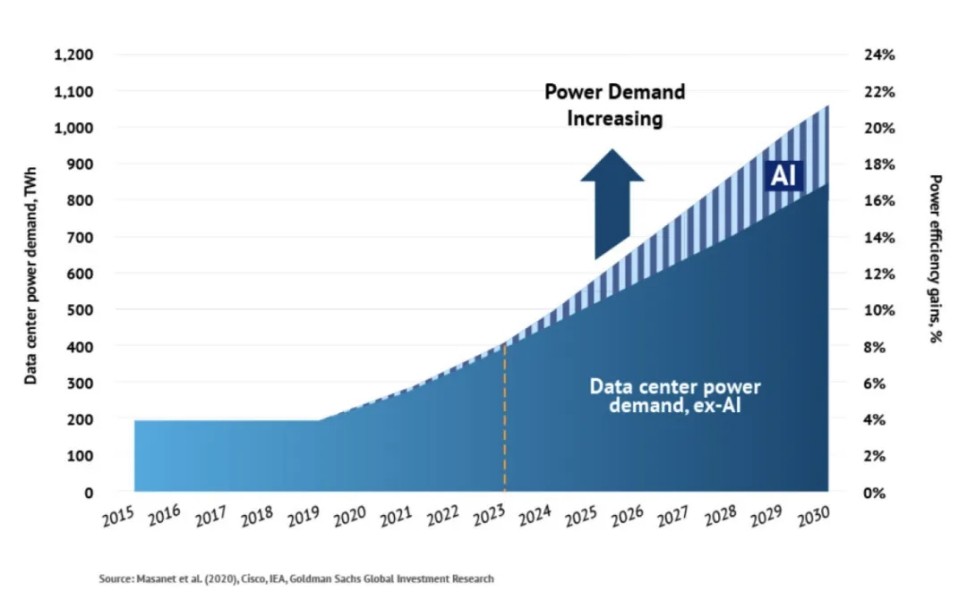
Figure: Changes in Global Data Center Power Demand, 2015–2030
Source: Masanet et al. (2020); Cisco; IEA; Goldman Sachs Global Investment Research
Within the CIO report's medium- to long-term research framework, AI infrastructure is expected to become one of the most important drivers of global investment in energy systems, power grids, and data centers over the coming decade.
As AI enters its third stage, it is becoming less like a series of apps and more like a power grid.
The essential value of a power grid lies in its indispensability. Its returns come from sustained, long-term usage, serving as both stabilizer and foundation within a portfolio. AI infrastructure assets increasingly display similar characteristics. Over time, they may form the base layer that supports AI capability at scale.
Moreover, AI-driven computing demand shows several highly predictable features: persistence, high density, and uninterruptable operations. As a result, power systems are emerging as one of the most rigid constraints in the AI era. This gives rise to structural trends worthy of sustained study, including:
Structural increases in electricity demand
Grid upgrades and regional bottlenecks
Enhanced long-term visibility in energy and related infrastructure investment
Within Noah's 2026 asset allocation research framework, AI infrastructure is viewed as:
A foundational asset class worthy of focused study within alternative allocations
A strategic bridge linking technological innovation with long-term capital
A structural portfolio component that enhances stability and global diversification
For the full set of conclusions and detailed wealth-allocation analysis, please refer to the CIO report.

Scan the QR code
To access the full H1 2026 Noah Holdings CIO Report