

At the Financial Times China Summit, Zander Yin, CEO of Noah Holdings, sat down for an exclusive interview with FT Chinese. The discussion, themed "From Algorithms to Art: New Wealth Choices in the AI Era," highlighted Noah's long-term approach and insights into managing global Chinese wealth.
In the interview, Zander Yin elaborated on Noah's AI strategy: "Human expertise with AI algorithmic power." This approach leverages technology to sharpen precision while preserving the essential role of human judgment and aesthetic sensibility in guiding long-term strategy. By combining technical capability with the art of service, Noah aims to deliver sustainable, high-quality client experiences. He emphasized that asset allocation in the AI era faces a dual complexity: the rapid evolution of technology and the intricacies of a highly integrated global investment landscape.
Wealth management, therefore, cannot rely solely on algorithms or technical optimization; it requires refined cognition and judgment. To cultivate these skills, Noah consistently publishes the NOAH Holdings | ARK Wealth CIO Reports ("NOAH | ARK CIO Report", "CIO Report"), helping global Chinese investors navigate an ever-changing world.
The series' trend forecasts recently caught the attention of Dianshi Investment (《点拾投资》), a respected financial media outlet. Its founder, Ang Zhu, observed in his annual feature, "A Year of Disruption: 2025 Global Order Revaluation and the Dawn of AI," that amid a total reconstruction of asset pricing, global order, and macro paradigms, the "Antifragile System" highlighted by NOAH | ARK CIO Report has played a crucial role in guiding asset allocation.
Having long tracked and translated annual outlooks from global buy-side leaders such as J.P. Morgan Asset Management, Bridgewater, BlackRock, and Fidelity, Ang Zhu noted: "The CIO Report does not attempt to provide a single annual 'answer' for the market. Instead, it continually refines a cognitive framework for navigating uncertainty."
Highlights from the Dianshi Investment Annual Feature
//2025 Multi-Asset Review: Risk and Safe-Haven Assets Rise Together
2025 saw an unusual phenomenon: risk assets and safe-haven assets rising simultaneously, challenging the traditional "Risk-on/Risk-off" paradigm.
Data Source: Wind; as of December 14, 2025.
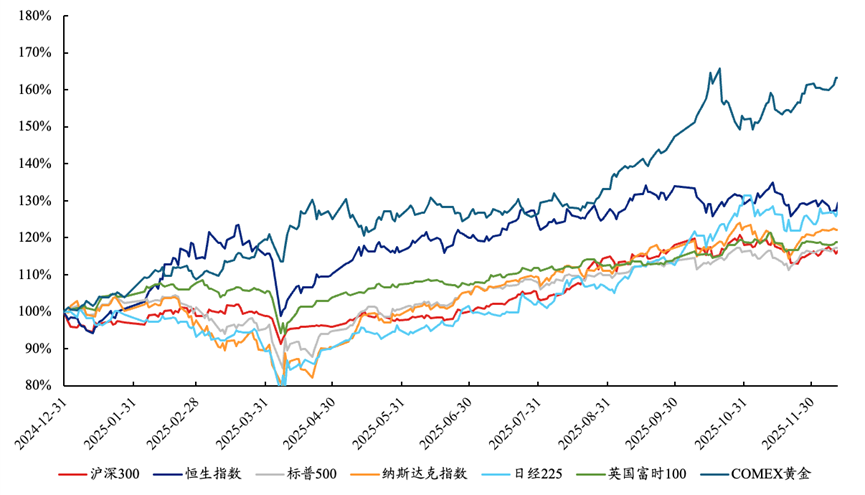
Source: Wind; Data as of December 14, 2025
//01 A-Shares and Hong Kong Stocks: Valuation Recovery and Policy Support
The 2025 A-share market reflected a "Confidence Reconstruction." After an early-year liquidity shock, the Shanghai Composite Index traced a W-shaped bottom, supported by the National Government and major policy adjustments. The CSI 300 Index rose approximately 15% over the year. Hong Kong stocks recovered ahead of global liquidity turning points, with the Hang Seng Index climbing around 30%. As Chinese assets regained appeal, global investors rotated away from overvalued markets like India, favoring the more cost-efficient Hong Kong market.
Active equity funds also made a comeback, with the Wind Equity Fund Index gaining over 28%, significantly outperforming the CSI 300. After three years of underperformance, Active Alpha returned. Historically, equities skewed toward growth factors tend to outperform during structural rallies.
Structurally, the A-share market displayed a "dumbbell" profile: low-valuation dividend stocks and high-growth tech were winners. As risk-free rates fell below 2%, dividend-yielding assets—hydropower, banks, and infrastructure with yields above 4%—became sought-after "bond-like" alternatives. Simultaneously, AI-related sectors such as CPO, semiconductors, and computing power saw independent structural bull markets.
In Invesco's 2026 Investment Outlook, a weakening US dollar is highlighted as a key macro theme, with guidance to rebalance portfolios from the US to emerging markets, including a bullish stance on Chinese equities.
//02 US Stocks: AI Drives Divergence Among the "Magnificent 7"
US stocks in 2025 were both promising and challenging. Led by AI, the S&P 500 achieved double-digit gains for the third consecutive year. Early-year fears of a bubble were exacerbated by President Trump's April 2 "Liberation Day" tariff plan, causing the VIX to spike above 45. However, the market quickly adapted, turning the panic into a "Golden Opportunity."
By December 12, the S&P 500 rose about 17%, and the Nasdaq surged over 22%.
Yet the era of broad-based growth ended, replaced by sharp divergences. Nvidia and Microsoft led AI-driven gains, while Tesla and Apple lagged due to competitive pressures and perceived innovation fatigue.
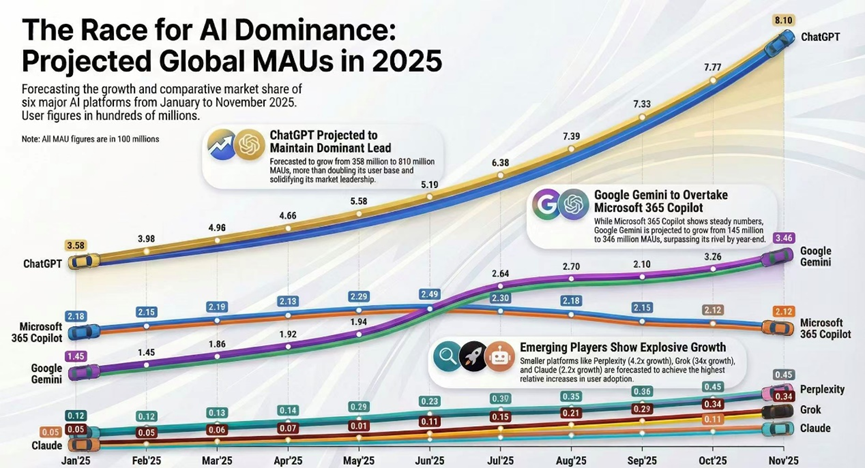
The most striking change is the rise of Broadcom. Leveraging its monopoly in ASIC chips, Broadcom's market capitalization surpassed Tesla's in 2025, joining the "Elite 8" with a year-to-date gain of over 60%, trailing only Google. This shift marks the expansion of AI investment from pure GPU speculation to broader infrastructure fields such as networking and storage.
The CIO Report published at the beginning of 2024, "Seize Small Certainties, Invest in Big Trends," predicted the US AI-driven rally, advising investors positioning in US stock ETFs. The H1 2025 CIO Report, "Leveraging the Process of Elimination to Identify the Optimal Solution" reinforced confidence for investors, underlining Noah's multi-asset, multi-regional strategy.
Similarly, in Invesco's 2026 Investment Outlook report, they highlighted a critical data point: in 2025, a small handful of AI companies contributed more than half of the S&P 500's total returns. This data suggests that the volatility of these few AI giants will have a significant impact on the US market.
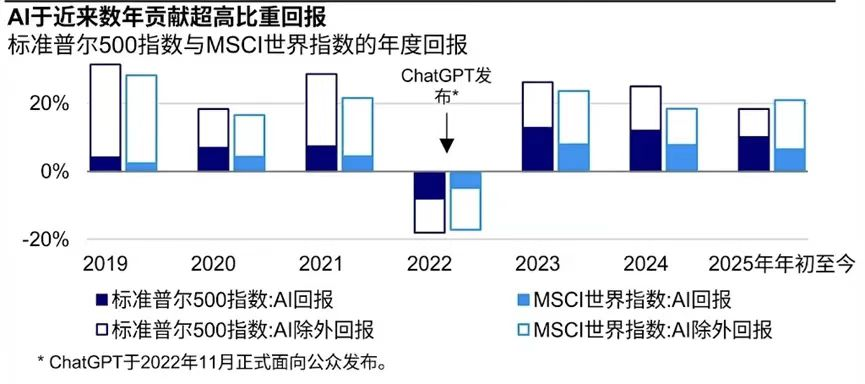
Source: Invesco; Data as of October 28, 2025
Another global asset management giant, BlackRock, emphasized in its annual outlook that AI has become the core engine of the economy. BlackRock predicts that AI-related capital expenditure could reach between US$5.0 to US$8.0 trillion by 2030, creating a massive financing "summit" long before revenues fully materialize. BlackRock also sees the AI narrative extending beyond the US to China and South Korea, and while maintaining an overweight stance on US stocks, it stresses the importance of actively selecting true "builders" and "beneficiaries."
The message from these global leaders is clear: while AI remains the dominant "Beta" trend, differentiation is intensifying, making astute stock selection more vital than ever.
//03 Gold: From Safe Haven to Credit Hedge
Gold surged over 60% in 2025, the largest annual gain since 1979, defying traditional real-interest-rate logic. Its role shifted from an inflation hedge to a credit and geopolitical hedge.
As global allocations evolve, gold increasingly replaces US Treasuries, establishing a feedback loop that reinforces portfolio allocations. This year, we saw a marked increase in investors building exposure through Gold ETFs.
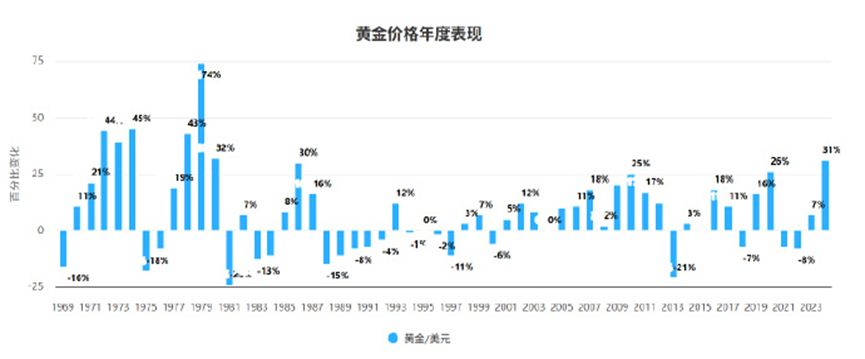
In our 1H 2025 CIO Report, we highlighted that geopolitical conflict and debt crises would be the most significant risks over the next five years. The most efficient way to hedge against these two risks is by holding gold assets. Noah Wealth was an early advocate for gold investment, recommending that investors build their exposure through Gold ETFs or QDII portfolios. In hindsight, this logic has been well-validated throughout the year.
//Core Theme of 2025: The Dawn of AI
An increasing number of observers are discovering that AI has become the most significant wave of technological innovation since the mobile internet. In the US, AI hardware giant Nvidia saw its stock rise by 30.0% this year, with its market capitalization surpassing US$4.3 trillion to become the world's largest enterprise. Another leader, ASIC chip giant Broadcom, saw its value surge by over 50.0%, overtaking Tesla and effectively expanding the "Magnificent 7" into the "Elite 8." Across A-shares and Hong Kong stocks, AI-related tech sectors have led the market; regardless of the region, AI has become the decisive factor in beating the index.
AI is not merely an industry; it is a brand-new factor of production. Its emergence has fundamentally altered capital market pricing and corporate valuation systems. More people are using AI tools to enhance efficiency, and an increasing amount of text-based work is being completed by AI. From writing long-form novels to creating beautiful images, AI is embedding itself into the fabric of our digital lives. In many fields, AI has already begun replacing entry-level workers. During a visit to institutional investors in the US this past summer, one remarked to me: "The most expensive asset on Wall Street today is a newcomer without experience." Within a few years, AI is poised to have a profound impact on the labor market.
Within our allocation framework of "Safety Cushion, Core Base, and Growth Engine," it is no surprise that certain assets are repeatedly highlighted. As early as our 2023 CIO Report, Noah Wealth identified the AI industrial trend as the most obvious long-term growth engine of this era, emphasizing its critical role in asset allocation.
This scope includes not only AI-related ETFs and companies, but also digital assets linked to the AI industry. Our 2024 report urged investors to recognize the "Giant in the Room"—the unmistakable AI megatrend. Over the course of our 2025 reports, we traced its evolution, noting how clear commercialization paths and supportive policies were powering its ascent in H1, and eventually introducing the concept of "Technological Deflation" in H2. This consistent narrative shows not only our early identification of the trend but our deep respect for its long-term impact.
I recall a brief conversation with Zander Yin, CEO of Noah Holdings, during the Noah Ark Global Chinese Wealth Management and Heritage Summit in Singapore. He mentioned that Noah has consistently invested in technology empowerment. Years ago, Noah digitalized various aspects of its offline business; later, it integrated the data behind every system to create meaningful data correlations. Today, we use human-supervised AI to enhance the user experience. For instance, our AI intelligent service, "Noya," proactively provides personalized allocation suggestions, giving every client a "super-powered" service representative. Many overseas SaaS companies have already achieved AI-driven customer service. Compared to human staff, these AI agents possess more robust knowledge bases, and the transformation of the service industry by AI is already yielding tangible results.
//Geopolitics: From Background to the Main Theme
In 2025, geopolitics stepped from the wings onto center stage, directly scripting the narrative of asset prices. From the global market volatility triggered by US tariff policies in April to the persistent regional conflicts throughout the year, it is clear that geopolitical friction has entered a state of "normalization." From a macro perspective, this new reality has shattered the three-decade-long paradigm of high growth and low inflation. Asset allocation can no longer rely on the globalization-centric logic of the past.
As geopolitics shift from "tail risk" to "primary driver," future asset allocation must treat normalized conflict as a baseline assumption. While the traditional Merrill Lynch Investment Clock and the global division of labor begin to lose efficacy, opportunities arise elsewhere. In our 2025 CIO Report, Noah noted that the trade tensions initiated by the US are profoundly reshaping the global economic, trade, and financial systems.
From gold to alternative assets, Noah has long provided actionable advice for escalating geopolitical shocks. Within our allocation framework, the CIO Report pioneered the concept of "Bridge Assets," using diversification and shock resistance to enhance portfolio resilience.
//Asset Allocation Under Antifragility
As 2025 draws to a close, we find ourselves at a crossroads where traditional investment paradigms show their age. The adage of "long-term holding of core assets" is challenged by their extreme volatility. While we once fixated on the "mood of the Fed," Chinese assets are now charting a course driven by their own internal logic. As "Black Swan" events become normalized, antifragility has become a vital component of modern asset allocation.
While most institutions still interpret 2025 through traditional frameworks, Noah has taken the lead in proposing "Antifragile Asset Allocation" as a core capability for the new era. Antifragility has risen to become part of our "Global Perspective." It is not about correctly predicting the future. It is about designing a portfolio so thoughtfully structured that it has the capacity to self-repair and even strengthen amidst uncertainty.
Noah first introduced the "Awakening of Antifragility" in 2023. In nearly every report since, we have reminded our readers that in an era of heightened uncertainty, constructing an antifragile portfolio is paramount. This approach involves diversification across regions, asset classes, and asset characteristics, ensuring the ability to survive even in "Black Swan" and "Gray Rhino" events.
In a recent interview, Zander Yin revisited the "Safety Cushion, Core Base, and Growth Engine" three-layer pyramid. This framework is built precisely around the philosophy of antifragility, embracing a simple truth: wealth management is not a sprint; it is a marathon of endurance.
At our summit on August 1, 2025, Yin engaged in a dialogue with the "Godfather of Antifragility," Nassim Nicholas Taleb. In Taleb's view, fragility is everywhere, and the wisdom of antifragility is the only moat truly worth building. When the world becomes uncertain, establishing an antifragile mindset can be a life-long benefit.
Similarly, J.P. Morgan's Market Outlook 2026 emphasizes using investment discipline to handle rising volatility, suggesting a balanced approach—such as a "dumbbell" strategy for Chinese assets (Tech + Dividends) or a mix of US and emerging markets for global investors. A more rational allocation framework is the best remedy for uncertainty.
//Bidding Farewell to the Past, Welcoming the Future
Standing at the threshold of a new year, we recognize that we are witnessing not just price fluctuations, but a fundamental reconstruction of the global economic order. As we look toward 2026, investors should focus on several key themes:
1.Monetary Policy Divergence: The Fed has entered a definitive rate-cutting cycle, while the Bank of Japan begins a hiking cycle. The ECB and PBOC are likely to remain on hold.
2.Technological Deflation: AI has shown exponential progress. As it permeates various fields, it will bring about "Technological Deflation," a phenomenon we have never seen at this scale. We will see inflation in non-AI sectors, but deflation driven by progress in AI-related fields.
3.Global Financial Reconstruction: The US dollar-centric system is likely a thing of history; the world is moving toward a new, multipolar order hedged by geopolitical realities.
4.Chinese Asset Revaluation: The trend of overweighting India while underweighting China has reversed. With improving fundamentals, the "double-tap" of earnings and valuation recovery will likely continue to propel the CSI 300 and Hang Seng Index.
This is the best of times for technological progress, as AI potentially enters its true "Year One" for the economy. It is also a confusing time for asset pricing. In this context, Noah's three-layer pyramid remains a highly effective tool for helping investors navigate these turbulent times with composure.