
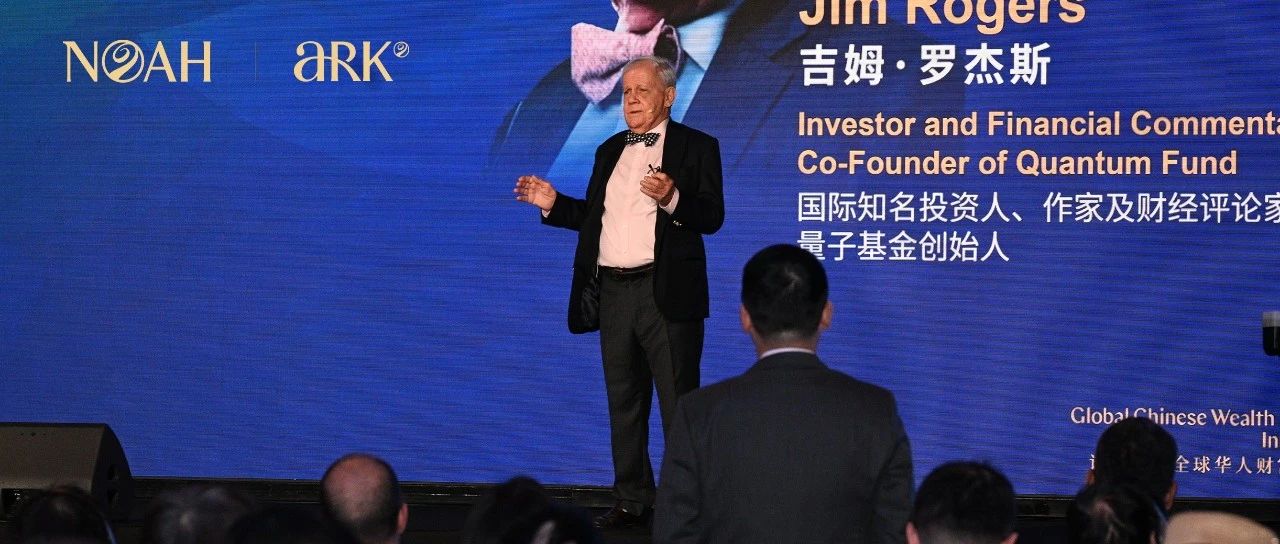
The inaugural NOAH's ARK Global Chinese Wealth Management and Inheritance
Summit recently held in Singapore was a resounding success. As Noah ARK's premier global wealth management platform for the Chinese community, the event drew nearly 600 new and existing clients and ecosystem partners from around the world to Noah ARK's global headquarters in Singapore. The summit brought together Chinese investors worldwide to explore resilient wealth strategies in an atmosphere of shared wisdom and trust.
At the summit, Jim Rogers, renowned investor, author, financial commentator, and Founder of the Quantum Fund, shared his insights on navigating today's world and his approach to wealth management, drawing from decades of investment experience, his educational philosophy, and frequent global travels.
Having navigated multiple economic cycles, Jim Rogers' insights sparked widespread discussion, particularly his comment about "clearing out U.S. stocks." Rogers' overall message then went deeper—he emphasized that investing is far from easy and requires deep focus on areas of personal expertise: "Don't listen to me, don't listen to anyone else." He highlighted the importance of understanding the world firsthand, and believes travel is essential for gaining deeper global insights.
Rogers' practical wisdom and these simple yet profound principles align closely with
Noah ARK's ethos: "Beyond wealth lies the wisdom of life." In the highly specialized
world of finance, becoming a better investor and building a brighter future demand continuous learning and trusted partnerships.
Noah ARK will continue to release content from the NOAH's ARK Global Chinese Wealth Management and Inheritance Summit. Below is an edited compilation of Rogers' key insights:
The Most Important Nation of the 21st Century—China
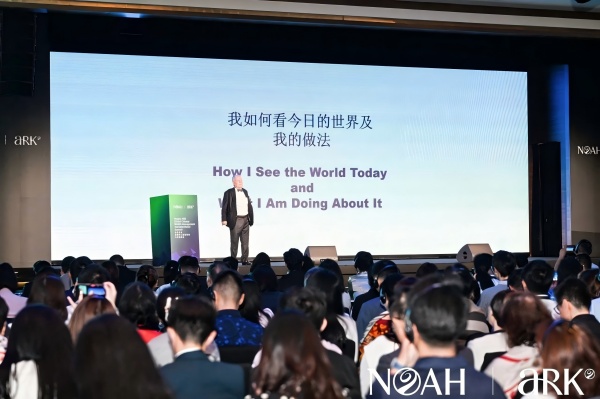
Jim Rogers first travelled to China in 1984, when the country was very different from how it is today. He vividly remembers visiting the Shanghai Stock Exchange in 1988, located on a muddy street with just one counter and an abacus—no calculators in sight. The simplicity was striking, but even then, Rogers sensed China's potential for growth.
Throughout history, China is unique as the only nation to have led the world multiple times—three or four, by some counts. Unlike Rome, Egypt, or Britain, which each held global dominance briefly before fading, China has repeatedly reemerged. Rogers is confident that China will be the most influential nation of the 21st century, and in many ways, it already is, with its significance only set to grow.
Acting on this belief, Rogers has prepared his family for a China-centric future. His two children speak fluent Mandarin, reflecting his conviction that it will be an important language in their lifetimes. When speaking in the West, he urges audiences to ensure their children and grandchildren learn Mandarin, emphasizing its importance in the years ahead. Rogers and his family have developed a deep connection to China, rooted in his early recognition of its potential. In the 1980s, while many predicted Japan would dominate the future, Rogers disagreed, pointing to China instead. Critics called him misguided, dismissing China as backward, but history has proven his foresight correct as China continues its remarkable ascent.
Rogers sees China's rise as inevitable. The 21st century, he believes, will be defined by China, whether the West embraces this reality or not.
Travel Is an Adventure That Deepens Global Understanding
Jim Rogers has driven around the world twice, motivated by a desire to understand global dynamics firsthand. He believed that experiencing the world directly would not only enrich him personally but also sharpen his perspective as an investor. Traveling the world from the ground up, while sometimes challenging, provided invaluable insights into its complexities.
In 1999, Rogers embarked on an extraordinary global journey starting in Iceland. His route took him across Europe, Turkey, China, Korea, Japan, Siberia, Russia, 32 African nations, Southeast Asia, Australia, New Zealand, South America, Central America, and Alaska, before concluding in New York. This three-year, 250,000-kilometer expedition earned him a Guinness World Record.
For Rogers, the journey was more than just a record-breaking feat. It profoundly deepened his understanding of the world. He views immersive observation as an unparalleled method for grasping global dynamics, offering lessons that shape both personal growth and investment decisions.
In Times of Crisis, Gold and Silver Are Safe Havens

"China is one of only two countries where I currently hold stocks. I've sold nearly all
my holdings in other markets, including the U.S. equities."
Over the past 15 years, global stock markets have experienced an extraordinary rally, with the U.S. market marking its longest bull cycle in history. Jim Rogers observes that widespread enthusiasm for the market is precisely what fuels his caution. He notes that the U.S. Federal Reserve has been printing money at an unprecedented rate and maintaining interest rates at historic lows in an effort to stimulate the economy. However, Rogers believes this approach is unsustainable, as interest rates cannot decline indefinitely. Acknowledging the possibility of being mistaken, he has already divested his U.S. and most global stock holdings.
Rogers expresses concern about global markets for two primary reasons: excessive money printing and the strength of the U.S. dollar. He views the dollar as a fundamentally flawed currency, particularly given the United States' status as the world's largest debtor nation. Despite this, he anticipates that in the next crisis, investors will flock to the dollar, perceiving it as a safe haven, even though he believes it is not truly safe. This expected surge in demand prompts Rogers to hold dollars, with plans to sell when their value peaks, provided he can time the market effectively.
On precious metals, Rogers has stated, "Gold and silver have long served as safe havens during crises, a pattern history consistently affirms. With gold currently at historic highs, I'm holding my position but would consider adding if prices correct. Silver, on the other hand, remains undervalued compared to historical trends, making it an attractive opportunity. I'm actively increasing my silver holdings, as its current pricing suggests significant upside potential."
Investing is Not Easy, it Requires Deep Understanding
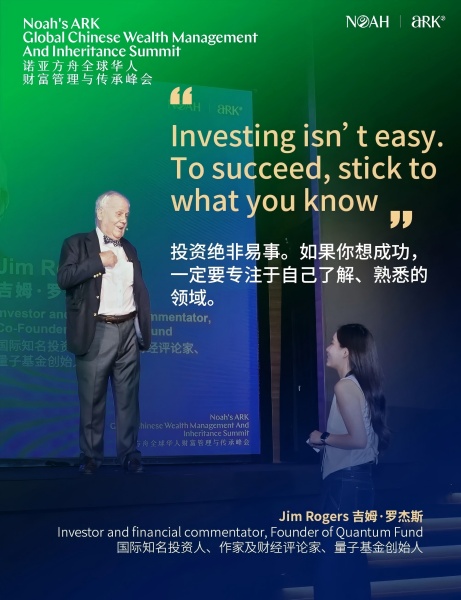
Jim Rogers emphasizes that asset allocation is a critical issue for investors, with the fundamental principle being to invest only in areas where one has a deep understanding. He observes that many investors chase hot trends or act on insider tips, but Rogers warns that such tips often lead to ruin. Instead, he advises sticking to what one knows well and avoiding investments based solely on others' recommendations.
Rogers proposes a thought experiment: if an investor were limited to just 25 investments in their lifetime, they would exercise extreme caution. In such a scenario, he argues, one would not act on a casual tip overheard in a restroom but would focus solely on opportunities they thoroughly understand.
To achieve success as an investor, Rogers advocates concentrating on areas of deep personal knowledge and ignoring external opinions. He stresses the importance of trusting one's own expertise above all else.
In closing, Rogers cautions that investing is far from easy, despite how magazines and television might portray it. His advice remains steadfast: stay disciplined and invest only in what you truly understand.